EuPMA - European Product Management Association
EuPMA is part of Open Innovation s.a.s.
For information or contacts: info@eupma.eu
European
Product
Management
Association

Key Question
What do customers really desire?
We drive the future of Product Management in Europe
It is a very dangerous mistake to simply imagine what customers want.
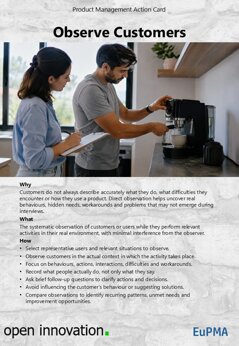
We need to ask them, observe them and learn from what they actually do.
Customer understanding should therefore start from evidence, not assumptions. Teams should avoid inventing needs in meeting rooms or projecting their own preferences onto users. The closer we get to real customer behaviours, situations, frustrations and aspirations, the stronger the foundation for product decisions.
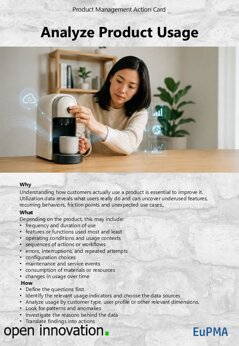
At the same time, customers may not always be able to clearly express — or even recognise — their deeper needs and desires. This is why Product Managers should combine different ways of learning: thoughtful questions, direct observation, examples, demonstrations, prototypes, comparisons, behavioural data and feedback from people who interact with customers every day.
The key principle is simple:
Start from the customer’s needs, problems, behaviours and experiences — not from our solutions.
Talking too early about solutions can bias the conversation and limit what we discover.
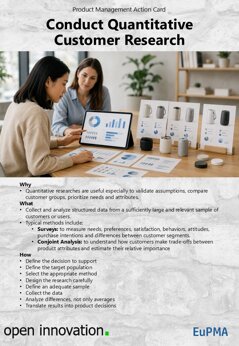
There are many ways to understand customers, including exploratory interviews, observation, surveys, workshops, user journey analysis, usage data, online feedback and insights from sales and service teams.
A useful approach is to organise this work into three logical moments.
1. Collect evidence from customers
Gather direct and indirect information about customers, users and their context.
The objective is to understand what they do, what they try to achieve, what creates difficulties, what they value, what they expect and what they desire.
Whenever possible, this phase should be based on real interactions and observable evidence rather than assumptions.
2. Structure and interpret what you have learned
Raw information is not yet product knowledge.
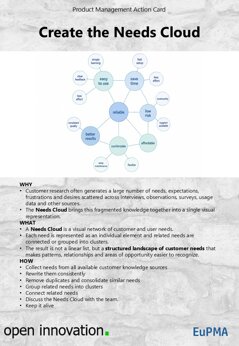
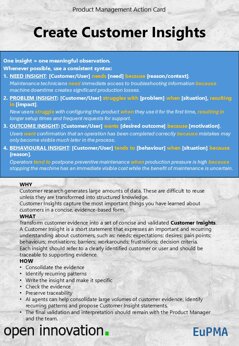
Interviews, observations, feedback and data need to be organised and interpreted in order to identify recurring patterns and meaningful insights.
This may include structuring:
- customer insights;
- needs and pain points;
- behaviours and motivations;
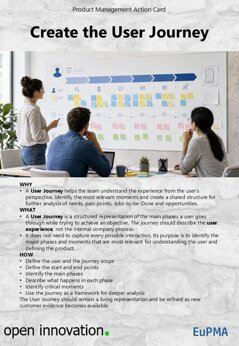
- user journeys;
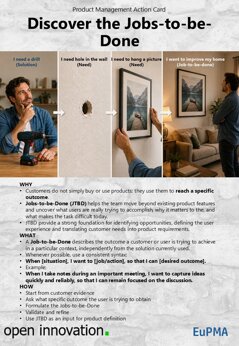
- Jobs to Be Done;
- desired outcomes;
- priorities and differences between customer segments.
This step transforms fragmented information into a shared and usable understanding of the customer.
3. Translate customer understanding into product direction
Customer knowledge must then be converted into indications for the product.
The team can progressively define:
- the experience the user should have;
- the activities the product should support;
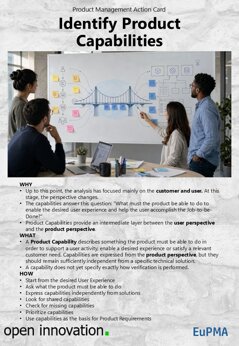
- the product capabilities required;
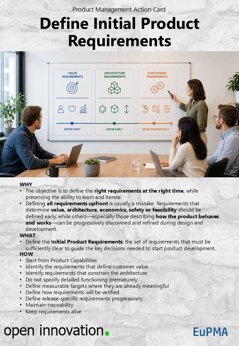
- the initial product requirements.
This creates a traceable connection between what customers need and what the product must be able to do.
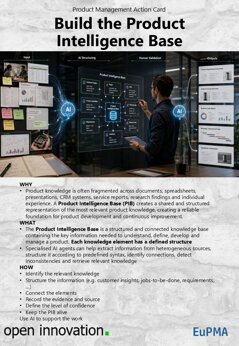
All customer-related knowledge should ideally be maintained in a structured, connected and easily accessible knowledge base (see the Product Intelligence Base), so that evidence, insights, Jobs to Be Done, capabilities and requirements remain linked rather than becoming isolated documents.
AI can significantly support the organisation, analysis, comparison and retrieval of this knowledge.
When access to real customers is not yet possible — or before starting customer research — specialised AI agents can also simulate different customer profiles. They cannot replace real customers or real evidence, but they can help teams prepare better questions, expose weak assumptions and explore perspectives that deserve to be validated.
Do not invent the customer. Ask, observe, interpret and then translate what you learn into better product decisions.
Product Management Best Practices
There is no single way to answer the question: "What do customers really desire?”.
Select the practices that best fit your product, available evidence, organization and level of uncertainty.“