EuPMA - European Product Management Association
EuPMA is part of Open Innovation s.a.s.
For information or contacts: info@eupma.eu
European
Product
Management
Association


Outcome Path
From user needs to product requirements
We drive the future of Product Management in Europe
Outcome Paths are recommended sequences of activities designed to achieve a specific product management result. They combine proven best practices and AI Agents to guide teams toward winning products and services.
A structured Product Definition Outcome Path that helps teams move from a deep understanding of users to clear, actionable product and service requirements.
The approach can be applied to physical products, software and services, in both B2B and B2C markets.
It combines three core elements:
- A structured and connected process, that guides the journey from user understanding to product capabilities and requirements.
- The AI Product Definition Engine, a set of specialized AI agents that supports and accelerates each step, improving consistency, traceability and the quality of product decisions.
- The Product Intelligence Base, where product knowledge is progressively structured, connected, validated and made reusable over time.
Outcome: a connected and traceable set of product requirements grounded in real user needs.
The process
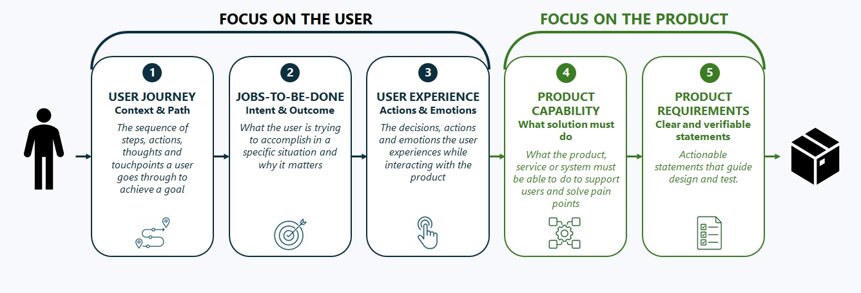
A structured path for transforming real user needs into clear, traceable and actionable product requirements.
The process starts from understanding what users are trying to achieve and how they experience the product or service and progressively translates this knowledge into what the product must be able to do and finally into requirements that can guide design and development.
1. User Journey
Map the main stages of the user’s interaction with the product or service.
The User Journey provides the context: when, where and why interactions happen, what the user is trying to accomplish, and where relevant problems or opportunities may emerge.
2. Jobs to Be Done
For each relevant stage of the journey, identify the real outcome the user is trying to make.
Jobs to Be Done shift the focus from solutions to the underlying outcomes users want to achieve.
3. User Experience
Describe the experience associated with each Job to Be Done.
Consider the actions, decisions, expectations, difficulties, perceptions and emotions that characterize what users do and how they feel accomplishing the job.
This step helps reveal not only functional needs, but also experiential and emotional expectations.
4. Product Capabilities
Translate user needs and desired experiences into what the product or service must be able to do.
Capabilities describe the product at a solution-independent level. They create the bridge between customer value and technical definition without introducing unnecessary design constraints too early.
5. Product Requirements
Convert the selected capabilities into clear, measurable and verifiable product requirements.
Requirements progressively define expected performance, constraints, interfaces, operating conditions and acceptance criteria, providing a solid basis for design, development and validation.
A Connected Product Definition
The value of the approach lies not only in each individual step, but in the connections between them.
Every requirement can be traced back to a product capability, every capability to a user need or desired experience, and every need to a specific Job to Be Done and stage of the User Journey.
The result is a connected Product Intelligence Base that helps teams maintain alignment between customer value and technical decisions throughout product development.
AI agents can support each step by helping teams extract, structure, refine and connect information. Human expertise remains essential to validate the outputs, provide context and make the final product decisions.
The AI Agents support
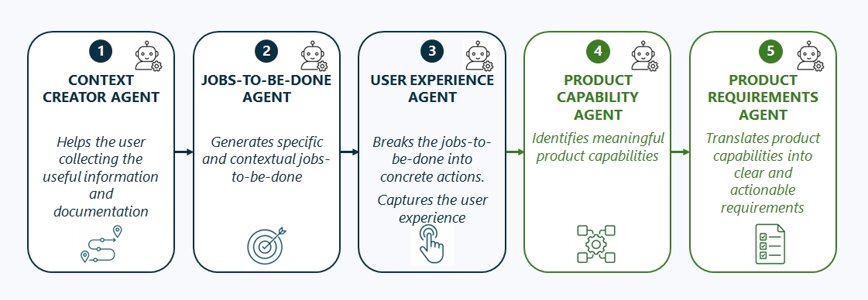
Definition Agents help build the Product Intelligence Base by transforming user understanding into structured product knowledge.
They guide the reasoning process step by step, from product context and user journey to jobs-to-be-done, user activities, product capabilities and product or service requirements. Each agent focuses on a specific level of analysis, helping teams make the transition from customer insight to actionable requirements clearer, faster and more consistent.
Their role is not to replace human judgment, but to accelerate exploration, organize information and support a more connected and consequential path from users to requirements.
Try it now: 30-minute exercise
Experience the requirements definition journey with a set of preconfigured AI agents.
Each agent is dedicated to a specific step of the process, but is not tailored to a particular industry, product category or company. This makes them suitable for experimenting with the method across different products and services.
The journey starts with the definition of the product or service context, the target user and the relevant stage of the user journey. From there, the agents guide you progressively through the generation and refinement of:
Context → Jobs-to-be-Done → User Experience → Product Capabilities → Product Requirements
Each step builds on the previous one, helping transform an initial idea into increasingly structured, coherent and traceable information.
You can follow the complete sequence or use individual agents independently, provided you supply the minimum input required for that specific step.
These agents are designed to let you explore the approach, test the potential of AI-supported requirements definition and understand how specialized, company-specific agents could provide even greater value.
What do you need to start
1. Sign in to a ChatGPT account. The agent can be accessed with the Free plan, but usage limits may interrupt the workflow or reduce the consistency of the experience. For more reliable and continuous experimentation, a paid plan such as ChatGPT Plus, Pro, Business or Enterprise is recommended.
2. The Product Definition agents are available here:
- Context Creator Demo Agent
- Job-to-be-done Demo Agent
- User Experience Demo Agent
- Product Capability Demo Agent
- Product Requirements Demo Agent
3. Download the ebook: “From user Needs to Product Requirements” and follow the instructions.
Do you need support in trying the process, or would you like to learn more about how it works and how it can be customized for your products and services?
Please contact us!
Download the ebook: “From user Needs to Product Requirements”